Wednesday, April 15, 2020
Benchwork 6
Sunday, April 12, 2020
Modeling Interest 4 - Locomotives
Based on my interests, the following prototype steam locomotives are of interest:
- Logging operations in British Columbia. There were two locomotives of interest: MacMillan Boedel 1044, a 2-6-2T with rectangular tank, and MacMillan Boedel 1055, a 2-6-2T with saddle tank.
- Logging operations in Gray's Harbor. Rayonier had 2-6-6-2 mallets operating in the Humptulips - Aberdeen area until 1959. Smaller logging companies used 2-6-2s and 2-8-2s
- NP 220 (a GP-9) located at Hoquiam for road service. NP 159, (a SW1200) located at Hoquiam for switcher service.
- MILW 619 (a SW1200) located at Hoquiam for switcher service.
- UP 112 (a GP7) located at Hoquiam for interchange service.
Wednesday, April 8, 2020
Benchwork 5
I then constructed and installed the Upper and Lower Deck (rear) L-Girders on the peninsula. The backdrop only extends 16' with a 4-foot open end. For the rear L-Girders, I installed an 8' 1"x3" L-Girder, then a 4' 1"x3" L-Girder, and then installed a final 8' L-Girder cantilevered into the final open 4' area. This 8' L-Girder was made from a 1"x4" for improved stability when cantilevered.
The Upper Deck Front L-Girder was constructed of two 1"x4" L-Girders 10-foot long, installed 24-inches from the backdrop and attached to the valance with the 19-gauge dark annealed steel wire.
The lower Deck Front L-Girders were constructed and installed using the same techniques. The cantilevered L-Girder was leveled and secured to a leg cut to size.
The Upper and Lower Deck Front L-Girder benchwork on the east wall was measured and cut to fit between the north and center peninsula benchwork.
I also installed Lower Deck String 1 along the north and east wall and parts of the Upper and Lower Deck Strings 1 and 2 to the upper cantilevered section.
Sunday, April 5, 2020
Modeling Interest 3 - Traffic
The traffic element includes 3 elements: 1) the types of trains to be run (streamline passenger v commuter, merchandise fast freights v local freights v mixed trains), 2) the traffic density (the number of trains to be run during an operating session), and 3) the length of trains to be run as indicated by Modeling Interest - Railroad Operations.
Types of trains to be run
- Passenger. Logging operations had logging camps near logging reload locations. Movement to cutting sites was often done by home made speeders or by flat car. The railroad would on a regular basis transport loggers lining in the camps to town on weekends. In the mid-50s logging camps were becoming obsolete as trucks became more prevalent and more loggers were living in local towns and commuting to cutting sites. My passenger modeling consideration suggested a local (perhaps mixed service) between Montesano and the logging camp.
- Freight. Industry practice on short lines and logging railroads suggest locals, usually run as extras, operating based on the demand of the customer. I would anticipate at least two freight trains serving coal and stone customers, one freight train serving the lumber company, and one freight serving the paper mill.
- Yard Switching. Freight traffic would move through a central yard, located near the Class 1 interchange locations. The yard would classify the incoming cars in five sorts: 1) Interchange to NP, 2) Interchange to MILW, 3) Interchange to UP, 4) local freight north and south bound, 5) local switching. Yard switcher would usually do local switching within yard limits.
- Interchange. The Northern Pacific employee timetables listed a
75-car siding at Montesano, Washington. MILW and UP interchange tracks
are located at Melbourne WA. This would suggest three transfer runs daily.
Traffic Density
Traffic density is defined as the amount of freight moved. Small amounts are considered light density, large amounts are considered heavy density.
At the industry level, the size of the industry (in terms of cars received and shipped), the volume rate (cars loaded or unloaded per day), and the demurrage rate( the number of days the industry had to load or empty the car before a daily charge was made) often determined the size of the industry's siding.
A small industry with a small volume rate would rate a small siding with on call servicing. A medium industry with a large volume rate would rate a small siding with daily servicing or a large siding with alternate day servicing. Large industries with mismatched sized sidings would require multiple servicing per day, often suggesting a dedicated railroad switcher assignment, or an industry owned switcher.
Heavy Industry
- Logging. Movement of logs from the reload site to the sawmill would be by logging train. Logging railroads in the Grays Harbor area loaded between 60-and 120-flat cars per day. Based on the size of the sawmill I anticipate daily activity would be 24 logging cars inbound, and 10 boxcars, flat cars or gondolas outbound daily.
- Pulp and Paper. The paper mill would see a variety of loads and empties - chips in open hopppers and gondolas, chemicals in tank and boxcars, finished paper in boxcars, fuel in hoppers and gondolas. Chips would be loads in and empties out. Chemicals would be loads in and empties out. Finished paper would be empties in and loads out. Daily activity would be 15 to 20 cars.
- Coal Mine. The coal mine would see empty hoppers and gondolas in and loads out. Occasionally the coal mine could receive supplies in boxcars and flat cars. Based on the size of the coal mine I anticipate daily activity would be 14 hopper or gondola cars inbound and outbound.
- Sand and Gravel. The sand and gravel processing area would see empty hoppers and gondolas in and loads out. Based on the size of the sand and gravel plant I anticipate daily activity would be 4 hopper or gondola cars inbound and outbound.
- Creosote Plant.The creosote plant would see loaded gondolas and flat cars of raw materiels of cedar poles and unfinished railroad ties either daily or several times per week. The plant would also see a loaded tank car, probably weekly.
- Pole Yard. The pole yard would see empty flat cars or gondolas in and loaded flatcars or gondolas out, probably one or two a week.
Length of Trains
The WWSL is a class III shortline. Based on the overall size of the
layout, I determined that the longest train would be no more than eight 50-foot boxcars, with no more than 75% of the cars being delivered to any
single industry.The next blog will discuss locomotives and rolling stock interests.
Wednesday, April 1, 2020
Benchwork 4
Benchwork continues in Zone 2 and 4. The upper and lower front L-girders are assembled and installed.
The first step is temporarily clamping a vertical 1"x3" to the valence.
With a length of 29-feet, i used three 10-foot 1"x4"s for the top L-girders.The first L-girder is clamped to the end L-girder. The other end of the L-girder is clamped at the vertical with a second clamp. Each L-girder is leveled horizontally with a 4-foot level and cross leveled with a 2-foot level. Once correctly leveled the L-girder is attached at the end with a rafter angle plate and temporarily screwed at the other end to the vertical 1"x3".
At the other end of the wall a second L-girder is attached and installed in the same manner.
The third (center) L-girder is aligned with the two end L-girder and cut to fit. A rafter splice plate is then screwed at each connection point.
Sunday, March 29, 2020
Modeling Interest 2 - Industry
In Layout Design Process 4 - Railroad Modeling I identified that the
layout design process can be broken down into three primary functional
areas: Concept, Structure and Layout Detail.
Concept identifies the: Who,What,Where, When and Why aspects of the
layout development process.
In this blog we will discuss the second of the five elements of Concept 2) Specific modeling interests - Industries
Industry
Freight cars are loaded and unloaded on four classes of track: industry, freight stations, team and intermodal. This includes
heavy industry, light industry and urban industrial areas that allows
switching operations. fIn previous blogs we discussed my interest in modeling 1950's Pacific Northwest, particularly Grays Harbor County, WA. Railroads in the County were primarily focused on moving natural resources.
Lumber. My interest in logging suggests a logging camp and reload facility. Logging industry activities include sawmills, planing mills, chip mills, pulp and paper mills, veneer and plywood mills, pole and wood product preservation companies.
Coal Mining. My interest in coal mining suggests a coal breaker, a sizing tipple, a coal washing plant, and a loading area for multiple sizes of coal.
Sand and Gravel Processing. My interest in sand and gravel processing suggests a processing area for sizing and processing gravel, a second area for sizing and drying sand, and outdoor and silo storage areas for sand and gravel, and a loading area for both products.
For my purposes, I am going to define industry in three types based on the square footage I am going to allot the industry on my railroad: heavy, medium and local switching.
- Heavy Industry will consist of:1) the logging camp, the reload facility, sawmill planing mill and chip mill, and in a separate location, 2) a pulp and paper mill.
- Medium Industry will consist of 3) a coal mine with coal breaker sizing tipple and a loading area, and 4) a sand and gravel processing area with a processing area for sizing and drying sand and outdoor and silo storage areas for sand and a loading area for gravel.
- Light Industry will consist of 5) a creosote plant and 6) wood pole distributor.
- Light Switching will consist of common small town distributors of coal,lumber, natural gas, fuel and oil.
Freight Stations.
Freight stations are the railroad owned depots at which less-than-carload (LCL) traffic was received and delivered. While I do not anticipate large amounts of LCL traffic, freight stations are the admin locations of station agents /car distributors who are responsible for car waybilling and customer service.The Northern Pacific maintained a freight station at Montesano, so I would anticipate that any LCL freight for WWSL customers would end up there for delivery. I anticipate having one freight station, primarily for freight administrative operations. As a 'exception to the rule' operation, the station could be used for large shipments transloaded or transferred to the WWLS freight station by truck or interchange.
Team Track.
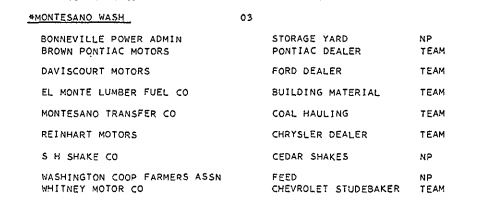
Team tracks serve industries which either are not located on the railroad or which receive and dispatch carload shipments too rarely to justify having their own siding. The Northern Pacific had three industry spur tracks and a team track in Montesano and had 6 companies identified as using the track:
I anticipate having one team track associated with the WWSL freight station. This team track could be used for unusual loads that may be transported to the woods, although i suspect that it would primarily be used by the WWSL for the loading of Christmas trees during the late fall, a seasonal activity done by quite a few railroads serving forest production companies. There would be no overlap of services with the NP team track.
Intermodal (TOFC/COFC).
TOFC/COFC became a major source of freight traffic around 1960. I have not found any indication of TOFC/COFC operations in the Gray's Harbor region, and do not plan on having said on the WWSL.
Wednesday, March 25, 2020
Lighting 2
i began to install Upper Deck String 1. I started at the left end of the north wall valence where i had installed a controlled outlet. I marked each panel at 1', 3' 5' and 7'. Starting at the plug end of the string I installed one base at each mark using two 3/4 inch lath screws.
Each base then had a 9w 5000k LED lamp installed.